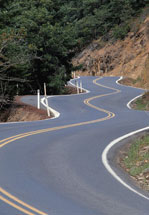
Straight Walker
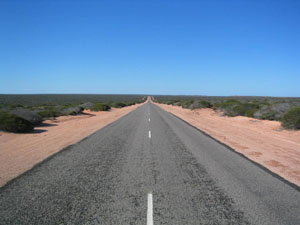
This is a straight road because it, well, looks straight. You can walk along it and not have to turn left or right.
A straight line on the surface of sphere is described by most mathematicians and physicists in terms of "parallel transport" when defining a geodesic (great circle): "A path on a curved surface is a geodesic if a tiny ant walking along that path wouldn't have to turn either left or right to stay on the path." (from sci.physics.research newsgroup thread on "Straight line"; also see John Baez's General Relativity Tutorial, which talks quite a bit about parallel transport and geodesics) The puzzle says "walks 8 miles in a straight line." So we should agree on what a "straight line" is, in the context of someone walking along the surface of a sphere. Since a true straight line would take you off the sphere's surface, the common definition is that the man "wouldn't have to turn left or right to stay on the path" (just like the ant mentioned above). If you and a friend are standing on the earth somewhere, and you tell your friend to walk forward in a straight line, you would expect them not to turn left or right. If the puzzle had read "walks 8 miles straight east," then we'd expect someone to always maintain an eastward bearing, which does not follow a straight line (it follows a circle/line of latitude). Don't forget that a "line" of latitude is not a straight line just because the word "line" is being used. All lines of latitude describe circles on a sphere. A circle is not a straight line -- it's a circle! In the context of a sphere's surface, only walking along a geodesic (great circle) is considered "walking straight" since only then do you not have to turn left or right. To argue that any circle is a straight line because it looks like a straight line to a Flatlander (as does any object when viewed from the side) -- well, it's something you can argue, but it only has relevance for fellow Flatlanders. Three dimensional beings generally find that concept illogical.
|